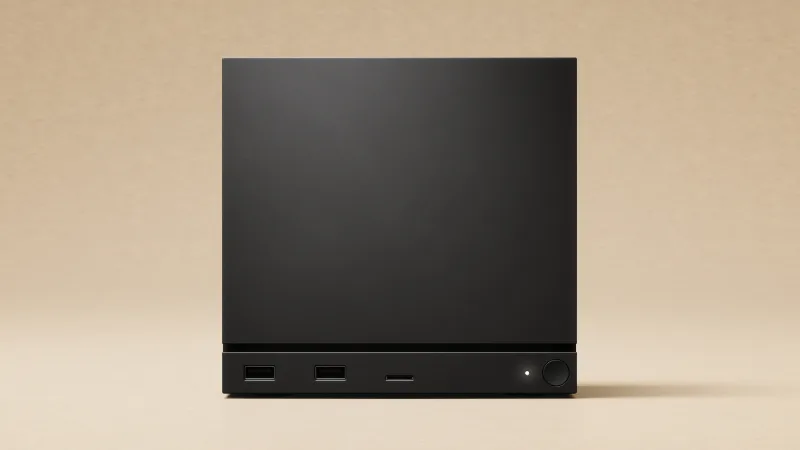
Valve's Steam Machine officially began shipping on June 30, and the first wave of independent reviews landed within hours of units reaching doorsteps. The verdict across outlets like Eurogamer, Digital Foundry, The Verge, PC Gamer, Tom's Hardware, and Tom's Guide is strikingly consistent: this is a beautifully engineered box let down by a price nobody — including Valve — is happy about.
What you're actually buying
The base model costs $1,049 for 512GB of storage, with a 2TB version at $1,349. Neither price includes a Steam Controller, which adds another $69. Inside the 6-inch cube sits a semi-custom AMD setup: a 4.8GHz Zen 4 CPU (6 cores, 12 threads) paired with a 2.45GHz RDNA 3 GPU carrying 28 compute units and 8GB of GDDR6 memory, backed by 16GB of DDR5 system RAM — split across a single SODIMM in early units, which costs real frame rate in CPU-heavy games . Valve has been upfront that the pricing reflects the ongoing DDR5 and SSD supply crunch rather than a change in ambition — components locked in over the past six months, not a markup.
Reviewers agree on the hardware and the software
Nearly every review leads with praise for the industrial design: a near-silent thermal setup (Tom's Guide clocked it around 20–21 dBA under load), a swappable faceplate, and a customizable LED status bar on the front. SteamOS itself gets similarly warm treatment — Digital Foundry called the overall package "beautiful hardware" with a genuinely premium feel, and reviewers repeatedly highlighted console-like touches such as HDMI-CEC support (turning on your TV when the Steam Controller wakes the box) that a typical gaming PC simply doesn't offer out of the box.
"The Steam Machine does what I want it to do — a well-designed box that brings together the complexity of PC gaming into a couch console experience that's really enjoyable when it clicks. But at $1,049, the underpowered parts are exposed and it's left feeling lost in the sea of better-priced competition."
That's Tom's Guide's summary, and it's a fair stand-in for the review cycle as a whole. PC Gamer landed on a three-star verdict, calling it "an expensive curio, rather than a gaming device for the masses." Tom's Hardware gave it 3.5 stars, praising the design and SteamOS integration while flagging the same performance-for-price gap.
Where the performance actually lands
In Tom's Guide's benchmarks, the Steam Machine's custom GPU trailed a comparably priced RTX 5060 PC by a wide margin: 36 FPS versus 82 FPS in Black Myth: Wukong at 1080p medium settings, and 17.7 FPS versus 45.4 FPS in Cyberpunk 2077 with ray tracing at 1080p. Ray tracing in particular is described as the machine's weak point — Cyberpunk wouldn't hold a stable 4K frame rate even with assistance from FSR, though a SteamOS beta shipped shortly after launch specifically targeting ray-tracing performance and VRAM management on 8GB-class GPUs like this one. The realistic pitch, per multiple reviews, is a 1080p-to-1440p machine that leans on FSR rather than a native 4K box, putting its real-world class closer to a PS5 or RTX 3060-tier PC than the "6x Deck power" marketing framing suggested at launch.
There's also a day-one compatibility gap worth knowing about before ordering: several major anti-cheat-protected titles, including Valorant, Call of Duty, Battlefield 6, and EA Sports' catalog, don't run on the Steam Machine at launch. Valve has not given a firm timeline for closing that gap.
Who this is actually for
The recurring theme, even from otherwise positive reviews, is that the Steam Machine makes the most sense for people who already love their Steam Deck and want a bigger-screen version of that experience, not as a straight console replacement. Older titles, indie games, and emulation reportedly run great, and SteamOS's desktop mode gives it real utility as a compact Linux PC. But for AAA gaming at the price of a PS5 Pro plus change, several reviewers pointed out that a similarly priced pre-built PC currently gets more raw performance for the money — you're paying partly for the six-inch form factor and partly for the console-like polish.
Valve's own Steam Machine store page still lists the reservation system that governed the initial launch batch, with a random-draw lottery used to cut down on resellers. Given how quickly the first units sold out, expect availability — and probably a fair number of scalped listings — to remain the bigger practical hurdle for a while yet.


No comments yet